Best Probiotic Mouth Sprays: How They Compare
We may earn a commission when you buy through links on this page, at no extra cost to you. Learn more
The best probiotic mouth spray names its strains (ideally S. salivarius K12, M18 or L. reuteri), states a CFU count, and fits a once- or twice-daily routine. Many spray listings name no strains at all. If you want longer contact with teeth and gums, a chewable such as ProDentim, a daily chew with three named strains, is our top all-round pick.

On this page
- Quick verdict
- Which probiotic mouth spray should you buy?
- How the sprays compare: strains, frequency, ingredients and price
- Do probiotic mouth sprays really work for bad breath?
- Spray or chewable: which form is better?
- Can you use a probiotic spray every day, and is it safe?
- Is your bad breath coming from your gut or your mouth?
- How oral probiotics fit together
- How to choose and when to see a dentist
Quick verdict
For most people, a named-strain chewable beats a vague spray, and ProDentim is our top all-round pick.
- Want one daily chew with several named strains? Pick ProDentim.
- Want K12 and M18 specifically, at a lower price? Pick Burst Oral Health Probiotics.
- Just want a cheap mint spritz on the go? CEELIKE Oral Spray is a breath freshener, not a named-strain probiotic.
- Skip sprays that don’t list strains or CFU.
Which probiotic mouth spray should you buy?
Buy a product that names its strains and states a CFU count, which is the number of live bacteria per dose. We judged each option on four things: named strains, CFU disclosed, simple ingredients, and cost per month.
Our top pick: ProDentim. It’s a daily chew, not a spray, but it’s the easy all-round option for the same goal:
- Three named strains in one product: L. paracasei, B. animalis subsp. lactis (sold as B. lactis BL-04) and L. reuteri, with 3.5 billion bacteria in total, the maker says.
- One tablet chewed each morning, so it stays in your mouth longer than a quick spray.
- A 60-day money-back guarantee and a six-bottle bundle at $49 per bottle.
Check the current ProDentim bundle prices and 60-day refund terms on the official site.
Visit the official ProDentim site60-day money-back guarantee
Best for strain transparency
Burst Oral Health Probiotics names BLIS K12 and BLIS M18 and states 6 billion CFU. It’s a lozenge, not a spray, and only two of its six strains are named.
Best for budget
CEELIKE Oral Spray 20ml is the cheapest option here at $10.99 a bottle. Its listing doesn’t name any probiotic strains or a CFU count.
Best for on-the-go freshness
CEELIKE is also the pick for a pocket-sized mint spritz. The maker says it’s alcohol-free and easy to use anytime.
Skip if
Skip any spray that lists no strains, no CFU or no ingredients. If you’re asking whether CEELIKE is safe, the maker says its products are safe, but the listing gives no full ingredient list to check against allergies.
The short version: named strains first, format second.
How the sprays compare: strains, frequency, ingredients and price
ProDentim leads this table because it names three strains and gives the best bundle price per bottle.
| Product | Format | Key strains | CFU | Daily use | Price per month | Guarantee |
|---|---|---|---|---|---|---|
| ProDentim | Chewable tablet | L. paracasei, B. lactis BL-04, L. reuteri | 3.5 billion total (maker) | 1 tablet each morning | $49–$79 per bottle | 60-day money-back |
| Burst Oral Health Probiotics | Chewable lozenge, 45 per pack | BLIS K12, BLIS M18 (+4 unnamed) | 6 billion | Not stated | $29.99 sale / $39.99 per pack | Not stated |
| CEELIKE Oral Spray 20ml | Mint spray | Not stated | Not stated | Not stated | $10.99 per bottle | No guarantee; 7-day returns on unused items |
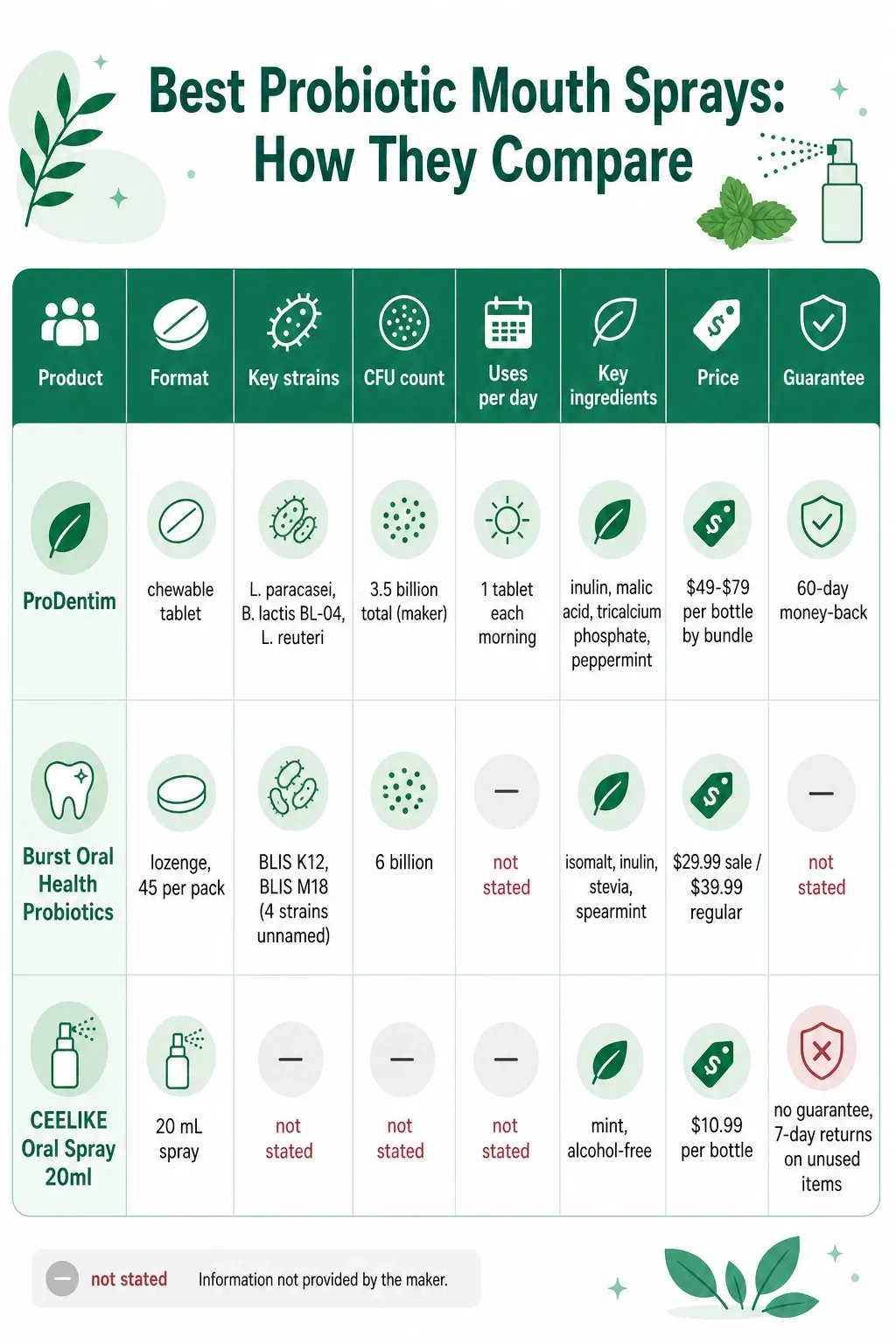
You’ll notice that none of these is a strain-named probiotic spray. Other strains you’ll see on labels include S. salivarius M18 and L. brevis; our strain guide on oral probiotics covers what each is linked to.
A full label beats a nice-looking bottle every time.
ProDentim
A once-a-morning chewable with three named probiotic strains plus inulin, malic acid, tricalcium phosphate and peppermint. The maker says it supports healthy gums, teeth and a balanced mouth.
Pros
- Three named strains in one chew
- 60-day money-back guarantee
- $49 per bottle on the six-bottle bundle, with free US shipping and three bonus guides
Cons
- Single strain amounts aren’t listed
- Two-bottle order is $79 per bottle plus $9.99 shipping
- Buy only from the official site to get the guarantee
See today’s ProDentim pricing and refund details on the official site.
Visit the official ProDentim site60-day money-back guarantee
Burst Oral Health Probiotics
Spearmint lozenges built around K12 and M18. The maker says they target odor-causing bacteria and help with tonsil stones.
Pros
- Names K12 and M18
- States 6 billion CFU
- Sugar-free, the maker says
Cons
- Four of six strains unnamed
- May contain trace milk protein
- No guarantee stated
CEELIKE Oral Spray 20ml
A low-cost, alcohol-free mint spray. The maker says it’s for refreshing everyday care.
Pros
- Cheapest option
- Easy to carry
Cons
- No strains or CFU listed
- 7-day returns only; single bottle misses free shipping
Do probiotic mouth sprays really work for bad breath?
Probiotic mouth sprays haven’t been well studied; most good evidence for bad breath (halitosis) comes from lozenges and tablets. Most bad breath comes from mouth bacteria making smelly gases called volatile sulfur compounds (VSCs).
A 2025 review of six trials with 360 people found probiotics lowered VSC levels in most studies, though the trials differed a lot and follow-up was short. That review also notes chlorhexidine mouthwash gives only temporary relief.
What the strains are meant to do
S. salivarius K12 is a friendly mouth bacterium studied for halitosis and tooth decay, including against cavity-linked germs like S. mutans. L. reuteri has been tested for gums: a trial of 120 people with gum disease found less inflammation and shallower gum pockets when used alongside care, and a small study of 16 children with thalassemia saw lower gum inflammation scores after 14 days.
Realistic timeline
Think weeks of steady use, not instant results. A small K12 trial of 28 people found no clear edge over placebo when tongue coating wasn’t cleaned first. So scrape your tongue too.
For instant freshness, any minty spray masks odor; probiotics aim at the bacteria behind it.
Spray or chewable: which form is better?
A chewable is usually the better form for a daily probiotic, because it stays in your mouth longer than a quick spray.

Contact time and dosage
Lozenges and chewable tablets dissolve slowly against teeth and gums. A spray mist is gone in seconds, and most don’t state a dose. For more, see our lozenge and chewable comparison.
Convenience
Sprays win for midday top-ups, travel and dry mouth. They’re like a breath mint you can keep in a pocket.
Where a chewable fits
If you want one simple morning step, ProDentim fits: one chew a day, three named strains, the maker says. Compared with mouthwash, chewables don’t rinse anything away; a chlorhexidine rinse is something your dentist should direct.
Try ProDentim with its 60-day money-back guarantee through the official site.
Visit the official ProDentim site60-day money-back guarantee
Can you use a probiotic spray every day, and is it safe?
Most probiotic sprays and chews are meant for daily use, once or twice a day; follow the label. The 2025 review reported no serious side effects in its trials.
Daily use
Check for allergens like milk and sweeteners you avoid. Stop if your mouth gets sore or irritated.
Antibiotics such as minocycline
Ask your pharmacist or doctor before taking probiotics with antibiotics such as minocycline. They can tell you about timing.
Is your bad breath coming from your gut or your mouth?
Most bad breath starts in the mouth, mainly the coating on the back of the tongue. If your mouth is clean and odor lingers, see a doctor to rule out other causes.
Natural ways to reduce mouth bacteria
- Scrape your tongue daily
- Floss once a day
- Drink water often
- Chew sugar-free xylitol gum
Quick tip: Scrape before your probiotic, not after.
How oral probiotics fit together
Sprays, lozenges and chews are all forms of oral probiotic, and the strain matters more than the format. Our guide to oral probiotics and what the evidence shows explains how they work. For more picks, see the best oral probiotics for bad breath, our full ProDentim review, or the best probiotic mouthwash options.
How to choose and when to see a dentist
Choose a product that names its strains and keeps its ingredients simple.
- Named strains (K12, M18, L. reuteri)
- CFU stated, ideally at expiry
- Clear daily dose
- No added sugar
The maker hasn’t published a study of ProDentim itself, but by these criteria it’s the best pick for most readers: three named strains, one daily chew, a 60-day guarantee and a $49 bundle price. If you want K12 specifically, Burst suits you; for a cheap mint spritz, CEELIKE.
Probiotics support brushing, flossing and dental visits; they don’t replace them. See a dentist for bad breath that won’t go away, bleeding gums or pain.
Compare ProDentim’s bundles and refund terms on the official site.
Visit the official ProDentim site60-day money-back guarantee
Frequently asked questions
How many sprays of oral probiotic per day?
Most probiotic mouth sprays are meant for once- or twice-daily use, but the right number depends on the product’s label. Follow the stated directions, since spray strength and CFU vary. If a listing gives no dose, that’s a sign to choose a better-labelled product.
Can a probiotic spray replace mouthwash?
A probiotic spray doesn’t replace brushing, flossing or any rinse your dentist prescribes. Mouthwash kills or masks bacteria for a short time, while probiotics aim to add friendly bacteria. Some people use both at different times of day; ask your dentist if you use a medicated rinse.
Do probiotic sprays help dry mouth?
A spray can feel soothing and convenient when your mouth feels dry, but probiotic sprays aren’t a treatment for dry mouth. Ongoing dry mouth can come from medicines or health conditions, so mention it to your dentist or doctor. Sipping water and sugar-free gum also help.