Oral Probiotic Strains Explained: Which Ones Are Studied and for What
We may earn a commission when you buy through links on this page, at no extra cost to you. Learn more
The most studied oral probiotic strains are Streptococcus salivarius K12 and M18 and Lactobacillus reuteri, plus a few other Lactobacillus strains. They've been tested for bad breath, gum health and cavities. Results are strain-specific and often from small trials, so the exact strain name and dose on a label matter more than the word probiotic.
ProDentim: A chewable probiotic supplement marketed for teeth, gums, and oral bacterial balance.
Visit the official ProDentim site60-day money-back guarantee

On this page
- What is an oral probiotic strain, and why does the exact name matter?
- Which oral probiotic strains are studied, and for what?
- What is Streptococcus salivarius good for, and which products contain it?
- What about L. reuteri and the other Lactobacillus strains?
- Is a 10-strain probiotic better than one with a few strains?
- How do probiotics differ from natural mouth-bacteria killers and antiseptic rinses?
- Are oral probiotics safe with antibiotics, colitis or other conditions?
- How to choose a strain: a simple decision checklist
- Where do oral probiotic strains fit in the bigger picture?
What is an oral probiotic strain, and why does the exact name matter?
An oral probiotic strain is a specific, named version of a friendly bacterium, and studies test strains, not probiotics in general. So “K12” on a label tells you far more than “probiotic blend.”
Strain, species and genus in plain words
Think of a dog: genus is the broad group, species is the breed, and strain is one particular dog with its own track record. In Streptococcus salivarius K12, Streptococcus is the genus, salivarius is the species, and K12 is the strain. A good label shows all three, plus the CFU (colony-forming units, a count of live bacteria) and the format, such as a chewable tablet or lozenge.
How oral probiotics work: competing with harmful bacteria
Oral probiotics are thought to work by competitive exclusion, which means friendly bacteria take up space and food so harmful ones have less room. A review of S. salivarius probiotics describes them as fostering a more balanced oral microbiome (the community of microbes in your mouth). Dysbiosis is the word for that community tipping out of balance.
So, do probiotics help oral health? A dental journal article says different strains, even of one species, can have different effects, so it depends on the strain.
Which oral probiotic strains are studied, and for what?
The strains below have the most research behind them, mainly for bad breath, gums, cavities and mouth sores. Ratings are our plain-language read of study size and type, not an official grade.
Strain reference table
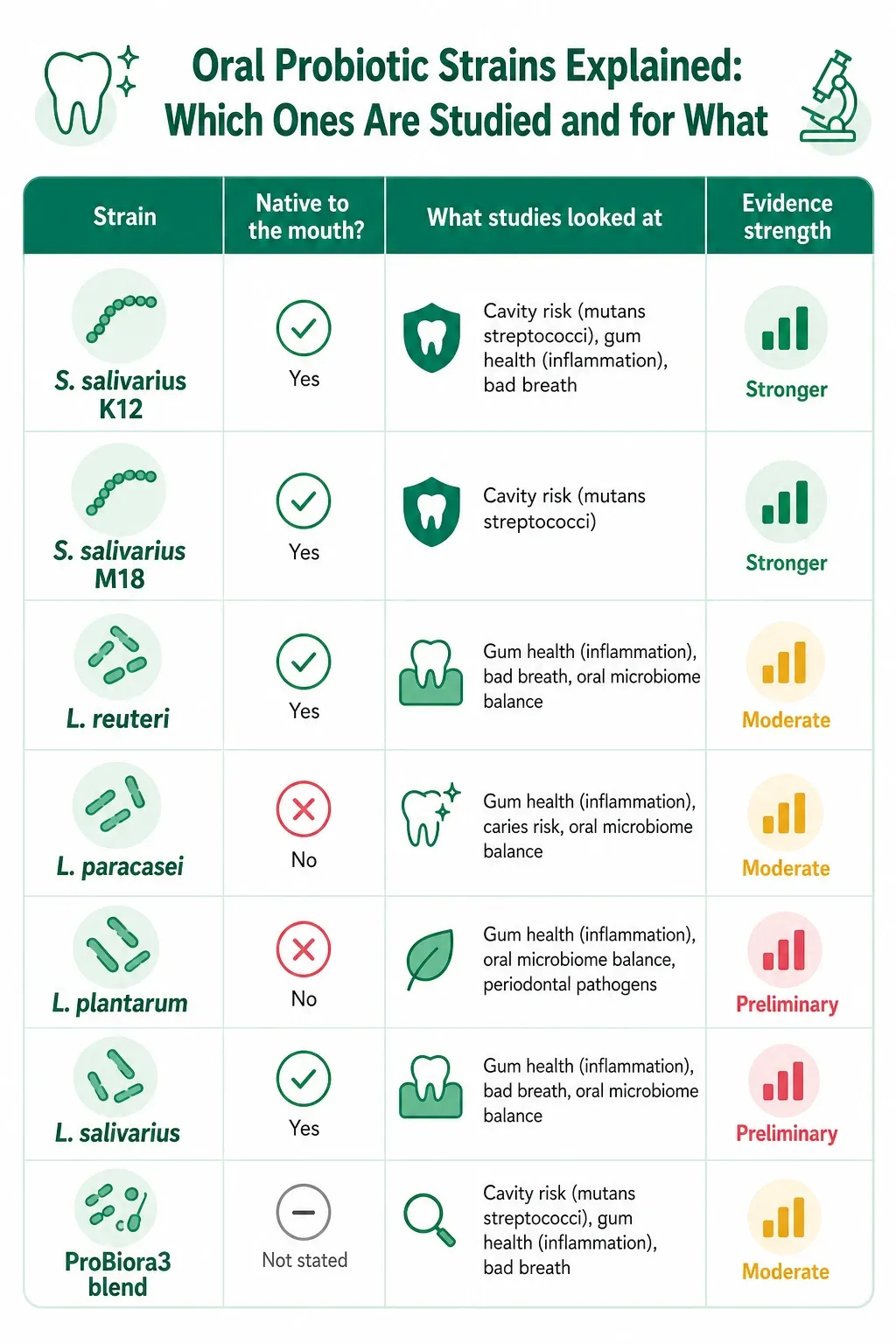
| Strain | Native to the mouth? | Studied for | Evidence strength |
|---|---|---|---|
| S. salivarius K12 | Yes | Bad breath, throat | Moderate; lab work on halitosis bacteria, some human data |
| S. salivarius M18 | Yes | Plaque, cavities in children | Moderate; reviewed in a pediatric review |
| L. reuteri | Mostly gut-linked | Gum inflammation, gingivitis, periodontitis | Moderate; small trials |
| L. paracasei | Varies by strain | Gum and plaque studies | Preliminary |
| L. plantarum | Varies by strain | Plaque, gum studies | Preliminary |
| L. salivarius | Yes (some strains) | Gingivitis; rat study on oral cancer | Preliminary |
| ProBiora3 blend | Mixed | Bad breath, plaque (blend) | Preliminary to moderate |
Which probiotics help mouth sores? Small trials of L. reuteri lozenges and others for recurrent aphthous ulcers exist. The evidence is early, and a dentist should check sores that keep coming back.
What is Streptococcus salivarius good for, and which products contain it?
Streptococcus salivarius is a bacterium that naturally lives on your tongue and throat, and its probiotic strains are studied for breath, throat and teeth. It’s one of the first microbes to settle in the mouth after birth.
K12 versus M18
K12 is mainly studied for breath and throat. A lab study found K12 held back bacteria tied to bad breath. For more detail, see our Streptococcus salivarius K12 guide.
M18 is studied for teeth. A systematic review of 15 pediatric papers reported a daily M18 tablet for three months was linked to less plaque and decay in children. That’s a review of mostly small studies.
To spot it on a label, look for “S. salivarius” with K12 or M18, usually in chewables or lozenges.
What about L. reuteri and the other Lactobacillus strains?
Lactobacillus reuteri is the best-known Lactobacillus for gum studies. A randomized trial of 30 people with periodontitis found lozenges added to deep cleaning were linked to more pocket depth reduction than placebo.
Mouth-native versus gut-native strains
A strain’s origin matters because gut strains may not settle well in the mouth. S. salivarius is a true mouth native. Many Lactobacillus strains come from the gut or food, so the oral studies for that exact strain are what count.
Other Lactobacillus strains have smaller bodies of work. L. paracasei and L. plantarum are mostly preliminary. L. salivarius has early data. A 2006 study of 59 people with gingivitis used L. reuteri and saw less plaque at the highest dose.
For more, see probiotics for gum health.
Is a 10-strain probiotic better than one with a few strains?
A 10-strain probiotic isn’t better by default, because more strains is not proof of more benefit. Look for strains with oral studies and a stated dose.
- Blends can dilute the dose of the strains that matter.
- Check that each strain has its own CFU count, not just one total.
- Format counts: chewables and lozenges keep contact with mouth tissue longer than a swallowed capsule.
ProDentim is one example of a chewable marketed for teeth and gums. The maker says it holds 3.5 billion bacteria across three strains, including L. paracasei and L. reuteri. Individual amounts aren’t published, and the maker hasn’t published a study of ProDentim itself. Our ProDentim review covers price and the 60-day guarantee.
Check the current ProDentim offer and refund terms on the official site.
Visit the official ProDentim site60-day money-back guarantee
How do probiotics differ from natural mouth-bacteria killers and antiseptic rinses?
Antiseptic rinses and natural options like salt water reduce bacteria broadly, while probiotics aim to add helpful ones. One cuts back, the other restocks.

One small study had 23 people use an antimicrobial mouthwash first, then a S. salivarius probiotic. So timing matters: take probiotics after a rinse, not at the same moment.
Brushing, flossing and cleaning your tongue stay the foundation. A probiotic is an add-on.
Are oral probiotics safe with antibiotics, colitis or other conditions?
Oral probiotics are generally well tolerated, but some people should check first. Higher-risk groups, such as people with HIV, should be careful.
- Antibiotics, including minocycline: ask a doctor or pharmacist about timing.
- Colitis or weakened immunity: talk to your doctor before starting.
- Bleeding gums or sores that won’t heal: see a dentist. A supplement isn’t a substitute.
Our side effects page has more.
How to choose a strain: a simple decision checklist
Pick a strain that matches your goal, then check dose, format and price per dose.
- Goal: breath points to K12, teeth to M18, gums to L. reuteri.
- Label: full strain code and CFU per strain.
- Format: chewable or lozenge for mouth contact.
- Price: divide the cost by the number of doses.
- Routine: use it daily for several weeks alongside brushing and flossing.
Quick tip: if a label only says “probiotic blend,” skip it or look for the strain list.
Where do oral probiotic strains fit in the bigger picture?
Strain names are the key to reading any oral probiotic label. For the full picture, see oral probiotics: what they are and what the evidence shows. If you want a product example, read the ProDentim review. Book a dental exam first if you have bleeding gums or lasting bad breath.
Frequently asked questions
How long do oral probiotic strains take to work?
It varies by strain and goal. Studies often run several weeks to three months of daily use, such as 12 weeks for L. reuteri lozenges. Results aren’t guaranteed, so use them alongside brushing and flossing.
Can oral probiotics replace brushing?
No. Brushing, flossing and dental visits remain the foundation of oral care. Oral probiotics are studied as an add-on to normal hygiene, not a replacement, and they can’t remove plaque the way a toothbrush does.
Are oral probiotics safe for children?
Some strains, like S. salivarius M18, have been studied in children, but products differ. Ask a pediatrician or dentist before giving any probiotic to a child, since doses and formats vary.